
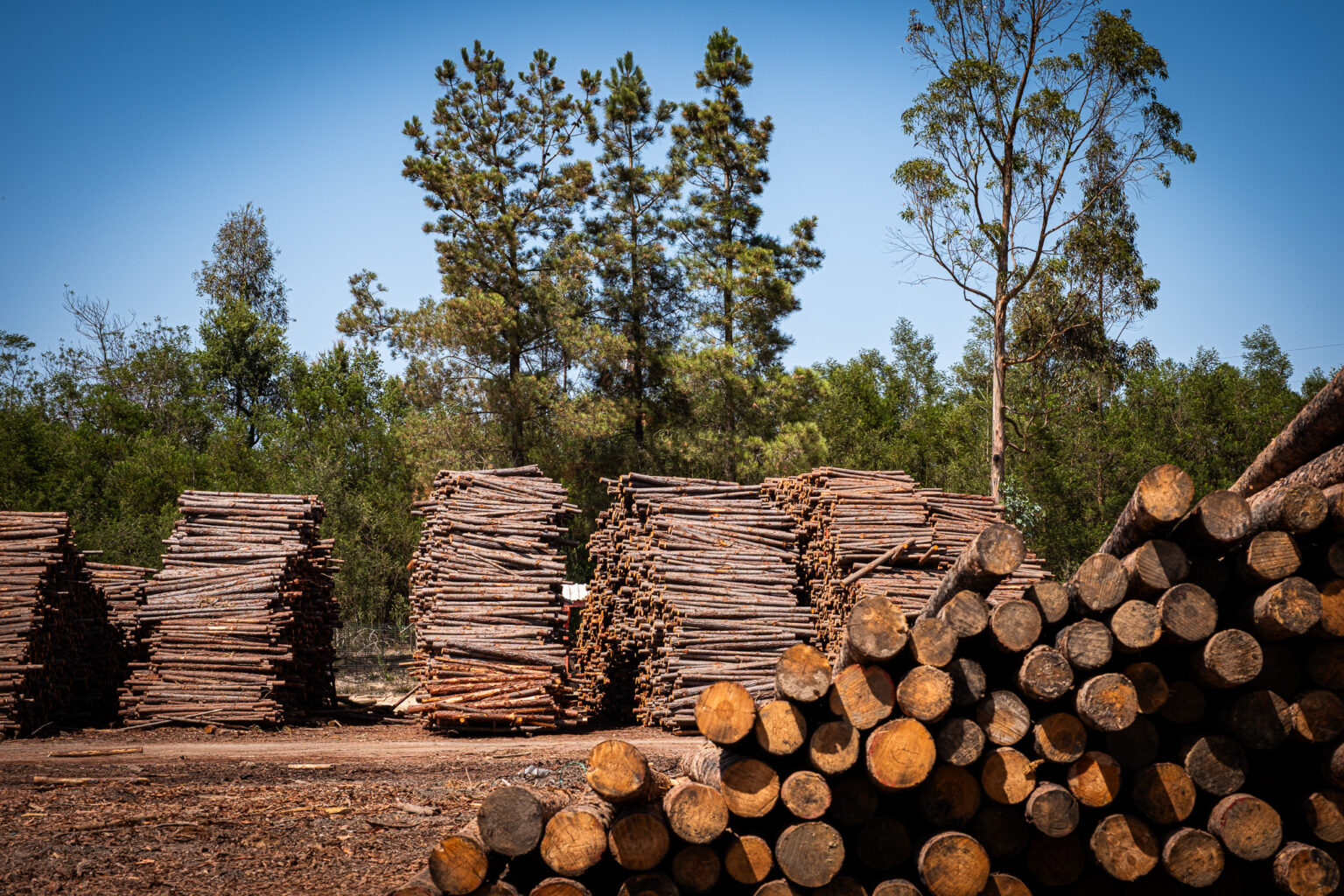
CarmoFarm’s treated wood poles begin in the forest, where the quality of the raw material stems from a combination of genetics and selective thinning.
The pine species used to produce CarmoFarm poles possess a rich genetic diversity, which is reflected in their physical and mechanical properties and their impregnation potential – all of which are ideal for the production of high-strength treated timber poles.
Combined with these genetic characteristics, the slow growth of the wood results in a high density of the material and, in turn, high mechanical strength in the poles.
In agriculture, treated wooden posts play a vital role in creating strong and durable structures. Used in vineyards, olive groves, orchards and agricultural fencing, they are constantly exposed to the conditions of the land and the elements. Therefore, the quality of the wood and the effectiveness of the treatment are crucial to ensuring the stability of the structures, reducing maintenance requirements and extending their service life over the years in agricultural use.
For CarmoFarm, managing the forest is not just about buying wood, it is also about wanting to add value to the forest by promoting reforestation and reducing the risk of fires, thereby adding value to a natural and renewable raw material.

And how? By doing what we do best: preserving wood through autoclave treatment.
THE STORY BEHIND THE TREATED WOODEN POLES
Rather than a scientific account of how we do it and why, here is my own account:
On one of my regular visits back to the CarmoFarm production plant in Pegões, I came across the head of the chemical treatment unit as he was starting one of the quality control procedures: cutting wood samples for impregnation testing.
I told him that I wanted to choose six posts at random from our finished goods storage area for him to cut, and that is what I did.
The employee cut the six posts exactly in half (critical impregnation zone) and took the six samples.

The image above doesn’t lie: the wooden post is completely saturated with a wood preservative.
The samples were subsequently sent to the CarmoFarm chemical analysis laboratory in Oliveira de Frades.
These laboratory results, along with the others we carry out every week, provide the answer to the question: Why is CarmoFarm the safe choice?
• Test of wood impregnation at the terminal, using a chemical reagent: in accordance with requirements.
• Copper salt retention in the wood end: 27 per cent higher than that required for CLASS 4SP (special protection).
How did we manage it? There’s nothing to hide:
• Raw material with approximately 99 per cent usable volume for chemical impregnation.
• State-of-the-art chemical wood treatment system: fully automated and utilising machine learning.
• State-of-the-art chemical wood treatment technology: A chemical triad offering the broadest spectrum of biological resistance, the highest preservation efficiency and the greatest environmental sustainability.
• Production teams who have undergone intensive training in the chemical treatment of timber and the treatment system.
• Quality control at every stage of treatment, carried out by the operator and by the machine itself.
• Laboratory testing and analysis using state-of-the-art technology: XRF (X-ray) equipment and chemical reagents.
• An engineering team providing real-time monitoring and maintaining constant contact with the supplier and all stakeholders.
• A team that is committed and motivated by the mission of adding further value to a valuable raw material.
Being the market leader in treated wood is no easy feat. Offering a 20-year guarantee – and even longer durability – on the timber is no easy feat.
Even if it were, it wouldn’t be a challenge for the CarmoFarm team! Nature, science and rigorous quality control: that’s what makes CarmoFarm the safe choice.
Miguel Palminha – Director of Operations at CarmoFarm