
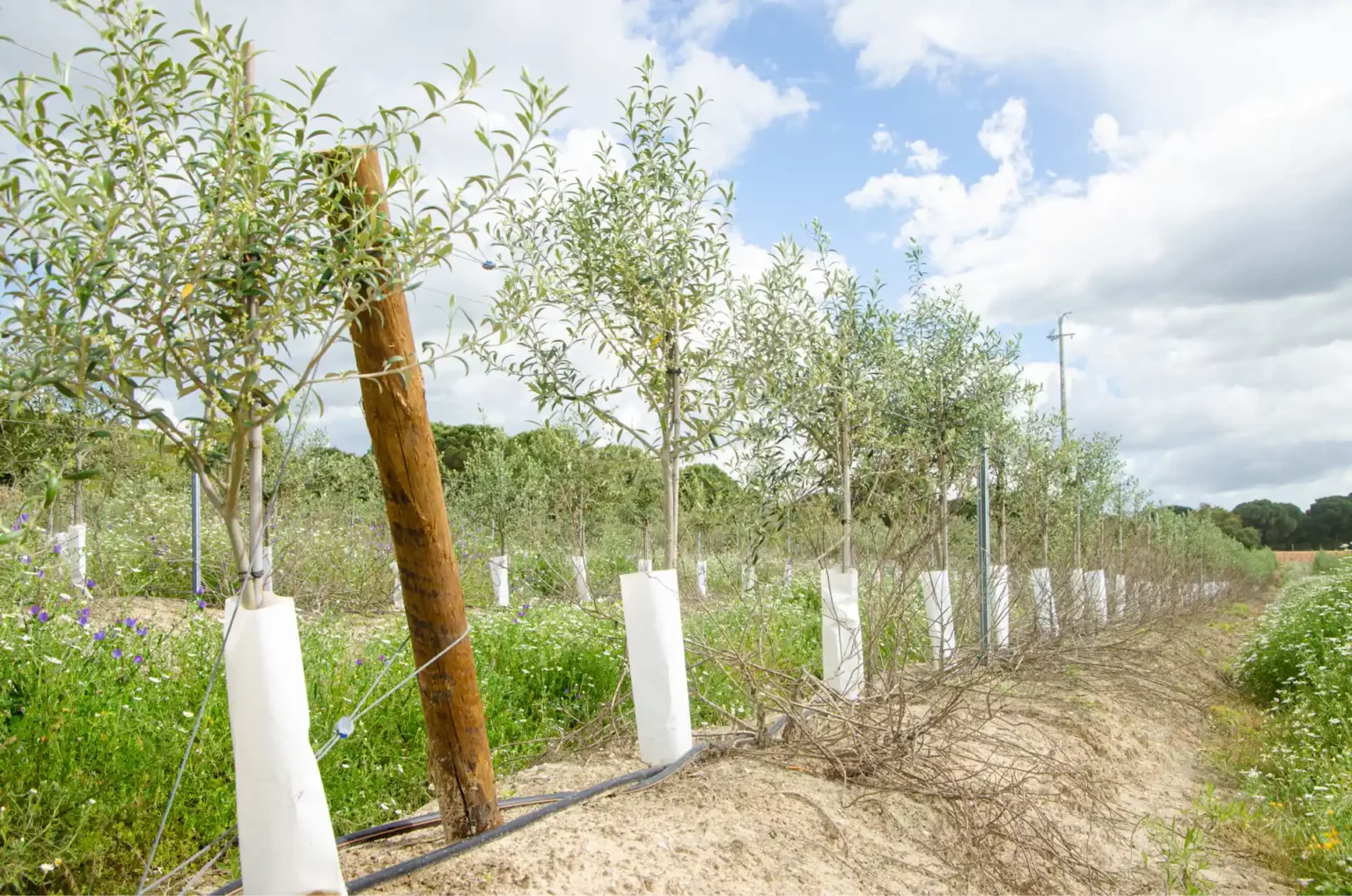
Olive growing in the Alentejo has undergone a veritable ‘revolution’ over the last 20 to 25 years. This progress was not solely due to the introduction of new technologies, but above all to technical advances: new, more productive and better-adapted varieties have emerged; denser planting patterns have been adopted; drip irrigation has become widespread; and new training systems have been introduced, significantly increasing the efficiency of the farms. All these changes together have placed the region at the forefront, profoundly altering the way olive oil is produced in the Alentejo.
Thanks to this continuous development, olive growing in the Alentejo has now, without a shadow of a doubt, become one of the most modern and professionalised sectors in the world. The combination of technical expertise, investment and an increasingly business-oriented approach to management has transformed the sector into a true international success story, serving as a benchmark for both traditional olive-growing countries and new producing regions.

Challenges Facing Olive Growing in the Alentejo
However, this growth brings with it significant challenges. The main challenge in the coming years will clearly be the labour shortage. This problem is already being felt significantly and is set to intensify, placing additional pressure on farms’ production capacity. To address this situation, it is essential to accelerate the mechanisation of all possible operations — from pruning to harvesting, including technical monitoring and the day-to-day management of crops.
The Future of Olive Growing
The future of olive growing — like that of most agricultural activities — will be characterised by greater mechanisation, digitalisation and precision at every stage of the production process. Real-time monitoring, the use of data, the optimisation of water and nutrient use, and the integration of smart systems will enable production to be more efficient, sustainable and profitable. At the same time, this technological evolution will also bring about a significant improvement in quality, a direct result of the greater efficiency and consistency provided by mechanisation and the rigorous management of each stage of production.
Bruno Cantinho – Managing Director, Olivogestão